When the Work Is Right and the Organisation Is Not Ready
The clearest signal that a high-performing team is operating beyond the organisation’s capacity to use them is not dramatic. There is no single moment where the gap becomes visible. It is a slow accumulation. Decisions that should be straightforward take months. Work that was produced to a high standard sits unused. Recommendations that were right three quarters ago are still being debated. The team keeps producing. The organisation keeps absorbing without converting. And the friction that builds in that gap is quiet, persistent, and corrosive in a way that urgency and effort cannot resolve.
When the Team Is Ahead
Some teams develop a way of working that requires a certain organisational maturity around them to function. Not just technical capability, though that is part of it. A disposition toward the long-term decision over the convenient one. A willingness to hold a position under pressure rather than adjust it to reduce friction. An ability to look at a programme of work and see not just what needs to happen now but what needs to be true in two years for the now decisions to still make sense. That combination of capability and conviction is rare. When it exists in a team it is genuinely valuable. And in the wrong organisational context it becomes a source of sustained and demoralising conflict.
The wrong organisational context is more common than most leadership writing acknowledges. It is characterised not by active resistance to good work but by a structural inability to meet it. Adjacent functions that have not built the capability the strategy requires. Delivery organisations that have had the decisions available to them for months and have not acted on them in any credible way. Change functions that treat every decision as a now decision because the organisational pressure for immediate visible movement is stronger than any discipline around prioritisation or sequencing. Each of these is a form of organisational unreadiness. None of them is necessarily the result of bad intent. But together they create a set of conditions in which a high-performing team cannot operate as it was designed to.
What follows is a specific and recognisable pattern. The team produces the work. The adjacent functions engage with it selectively, inconsistently, or not at all. Decisions that required months of architectural thinking get traded for shortcuts that resolve the immediate pressure without addressing the underlying problem. Those shortcuts accumulate. The gap between where the strategy points and where the delivery is actually heading widens. And because the architecture function rarely has delivery authority, only advisory authority, the team watches this happen without the organisational standing to stop it.
The friction this produces is not the clean friction of honest disagreement. It is the exhausting friction of a conversation that keeps restarting. The same decision revisited. The same long-term case remade. The same short-term pressure reasserted. And over time the team that was built to push for the right answer starts to recognise that the question is not whether their answer is right. It is whether the organisation is capable of acting on it. Those are different problems and only one of them is within the team’s power to solve.
What the Friction Costs
Friction at this level and duration does not stay contained. It moves. It starts in the work, in the meetings where decisions stall and shortcuts get chosen, and it migrates into the people doing the work. Gradually and then all at once.
The first thing that changes is how the team relates to its own output and its own relevance. Two things that are distinct but move together.
A team that was built around the conviction that their work matters starts to register that the connection between what they produce and what the organisation does with it is unreliable. The architecture is sound. The recommendation is right. The decision goes the other way anyway. That experience, repeated often enough, does something specific to professional motivation. It does not extinguish it immediately. It hollows it. The effort continues but the belief that underpinned it starts to separate from the work.
Alongside motivation sits something harder to articulate but equally damaging. A team that was built to shape the direction of technology strategy starts to question whether it is actually shaping anything. The outputs exist. The artefacts are produced. The decisions are documented. But when those outputs consistently fail to land, when the strategy that the team spent months developing gets quietly traded for a shortcut, the question that surfaces is not just whether the work is good. It is whether the work matters. Whether the function they are performing has genuine purpose or whether it has become a box that gets ticked before the real decision gets made elsewhere. That question, once it starts circulating in a team, does not stay quiet for long. It surfaces in how people talk about their work, in the energy they bring to the next piece of it, and eventually in whether they start looking for an environment where the answer is different.
The second thing that changes is how conflict gets handled. Early in this pattern the team engages directly. They make the case. They hold the position. They push back on shortcuts and explain the downstream consequences. That is the right response and it is the response a high-performing team with genuine conviction will naturally make. But when the pushback is consistently absorbed without changing the outcome, the nature of the engagement shifts. The team stops arguing for the right answer and starts managing the situation. Recommendations become options. The explicit recording of tactical decisions and their consequences replaces the attempt to prevent those decisions from being made. This is not a failure of the team. It is a rational adaptation to an environment where conviction alone cannot move the needle. But it changes the work fundamentally. And it introduces a dynamic that is difficult to escape. When the team does push back, as they still will on the decisions that matter most, they are no longer read as principled. They are read as defensive. The organisation that has already reframed them as blockers now has a second label available. Every time the team holds a position, the label gets reinforced. The pushback that was once evidence of rigour becomes evidence of an inability to collaborate. That reframing is deeply unfair and deeply common. And once it takes hold it is almost impossible to dislodge from within.
The third thing that changes is how the team gets seen by the organisation. This is the most corrosive part of the pattern. A team that holds the line on long-term decisions in an organisation that is oriented toward short-term delivery does not get seen as strategically rigorous. It gets seen as a blocker. The functions that are cutting corners know the corners are being cut. They know the architecture position is right. But acknowledging that is more expensive than redirecting the blame. So the team that was trying to prevent the problem becomes associated with the problem. Their credibility in the organisation is not eroded by the quality of their work. It is eroded by the political cost of being the function that keeps saying no in an environment that wants yes.
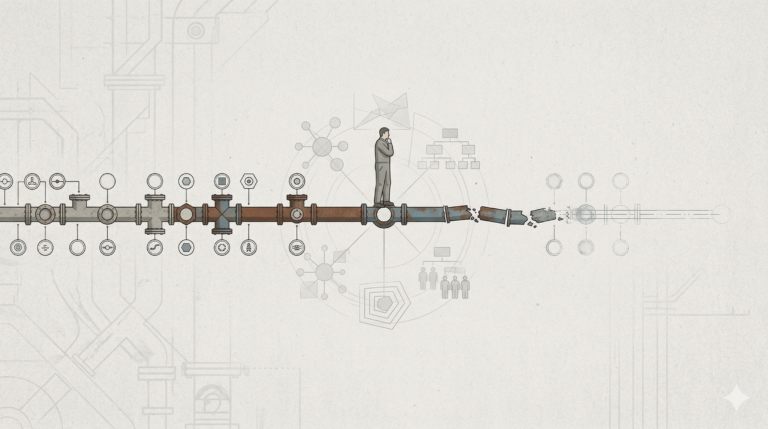
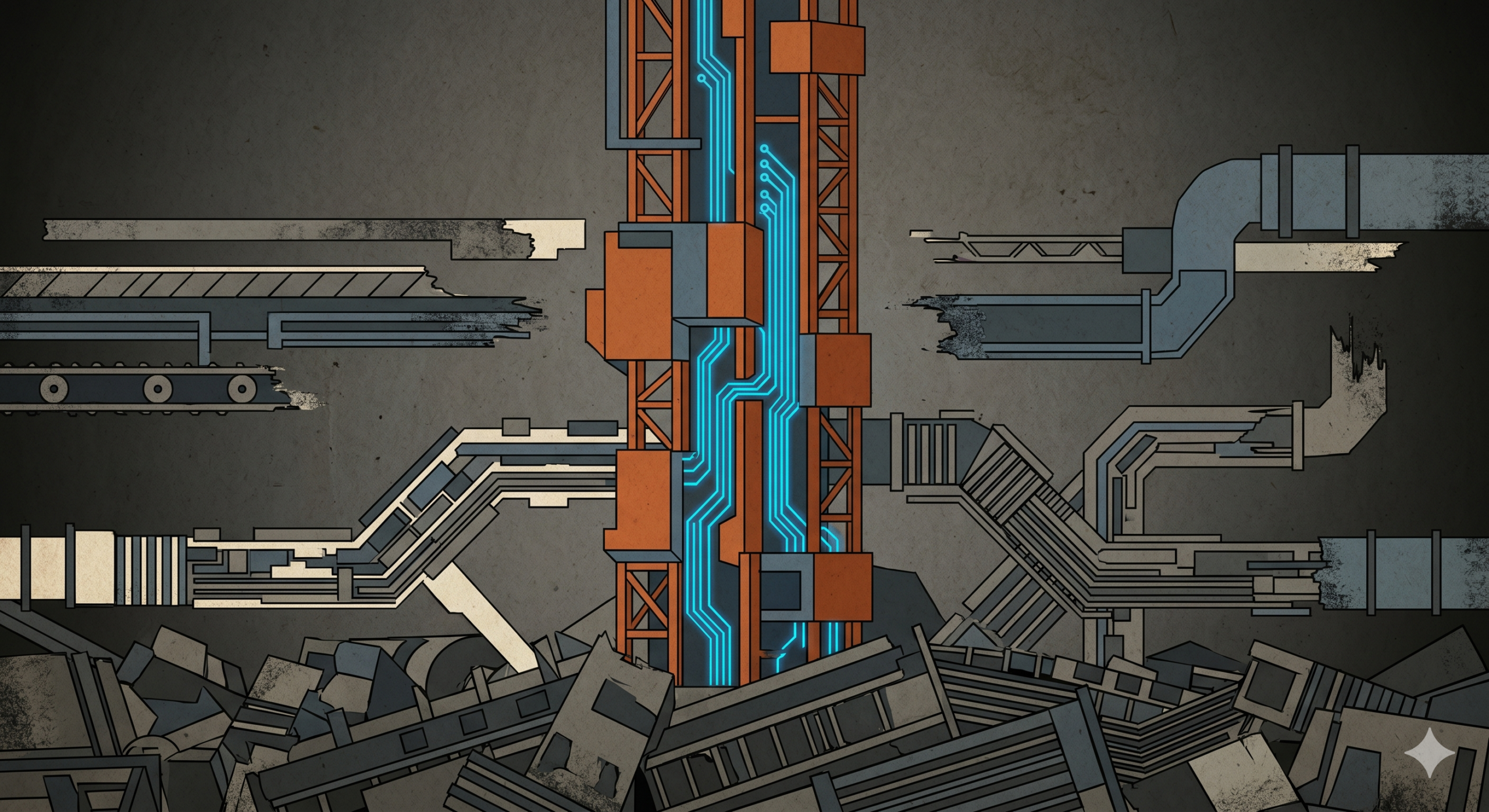
What is left is a pipeline full of the residue of these interactions. Not a clean failure. Not a clear success. A slow accumulation of deferred decisions, unresolved tensions, and workarounds layered on workarounds. The business value that should be flowing through that pipeline is still in there somewhere. But it is moving through sludge. The effort required to extract it keeps growing. And the people generating that effort are doing so with less conviction, less energy, and a sharper awareness of the distance between what they are capable of and what the organisation is actually using them for.
That awareness is the thing that has to be managed. And managing it while absorbing its full weight privately is the specific burden this edition is really about.
What Gets Carried
Carrying a team through this pattern from the inside requires a specific and largely unacknowledged set of capabilities. The ones that do not appear in competency frameworks because acknowledging them would require acknowledging the structural dysfunction that makes them necessary.
The first is the ability to maintain a credible sense of direction for the team while privately absorbing evidence that the direction may not land. The team needs purpose. They need to believe that the work they are doing is pointing somewhere real. Providing that belief does not stop being a responsibility because your own conviction is under strain. So you continue to set the direction, frame the work, and hold the team’s sense of purpose intact, while separately carrying the weight of what you are seeing in the conversations the team is not in. The governance meetings where the strategy gets quietly deprioritised. The stakeholder exchanges where the long-term position gets traded for something more immediately convenient. The slow accumulation of signals that the organisation is not going to close the gap on its own.
That separation between what you show the team and what you are privately processing is not dishonesty. It is a form of protection. But it is exhausting in a way that has no clean outlet. You cannot debrief with the team. You cannot name what you are carrying without undermining the very purpose and direction you are working to sustain. So it gets absorbed. Meeting after meeting, decision after decision, the weight accumulates in a place that has no release valve.
The second is the ability to continue advocating for the team in rooms where advocacy is becoming increasingly costly. As the blocker and defensive narratives take hold, interventions on behalf of the team start to carry a political cost that earlier they did not. Every time the case is made for the long-term position, it gets associated with the friction that position creates. Every time a shortcut gets challenged, that challenge gets filed alongside the team’s pushback as more evidence of a function that cannot be aligned. That is happening whether you name it or not. The advocacy continues anyway, because abandoning it would be a different kind of failure. But the cost is real and it compounds.
The third is knowing when the situation has moved beyond what any individual can fix from within. This is the hardest of all because it requires a clear-eyed assessment of something you are deeply invested in. There is a point in this pattern where the gap between the team’s capability and the organisation’s readiness is no longer a people problem. It is a structural one. Where the friction is not a symptom of misalignment that better communication or stronger stakeholder management could resolve. Where the sludge in the pipeline is not a temporary condition but a reflection of something the organisation is not currently capable of changing from within. Recognising that point, and being honest about it rather than absorbing another cycle of effort that produces the same result, is a form of professional integrity that is genuinely difficult to exercise when you are still inside the situation.
The instinct is to absorb one more cycle, to try one more approach, to believe that the right conversation or the right moment will shift something that has not shifted through many previous attempts. That instinct is not weakness. It comes from genuine investment in the team and the work. But there is a difference between persistence that is still productive and persistence that is simply postponing an honest assessment. It is the honest limit of what individual capability can do inside an organisation where the distance between what leadership signals as intent and what the operating model delivers on the ground is too wide for any one person to bridge.
When Functioning Is Not the Same as Delivering
The pattern this edition describes is not unusual. It is not even particularly visible from the outside. Large organisations absorb it. The governance forums continue. The programmes stay on the roadmap. The reports go upward showing progress and metrics that people are invested in and people who genuinely believe that improving the metrics improves the functioning. The organisation looks, from a sufficient distance, like it is functioning.
What is harder to see from that distance is what the functioning is costing. The capability that is present but not being used at the level it was built for. The strategic work that is being produced and not acted on. The people who came with conviction and are leaving with something quieter. Not anger exactly. A kind of professional deflation that takes longer to recover from than most organisations account for when they think about attrition.
The sludge does not announce itself as a crisis. That is precisely what makes it sustainable for longer than it should be. Each individual decision that feeds it is defensible in isolation. The shortcut that resolved the immediate pressure. The prioritisation that responded to what the business needed now. The capability gap that was acknowledged but not addressed because the programme could not wait. Taken one at a time, none of these look like organisational failure. Taken together, over time, they produce a delivery pipeline where the ratio of effort to value has inverted. Where the energy required to move anything meaningful through the system keeps growing while the output at the other end keeps shrinking.
The question that does not get asked often enough is what the cumulative cost of that inversion is. Not in the next quarter. Over three years. Over five. The organisation that was once capable of generating genuine long-term technology value is now optimised for something much smaller. Surviving the next delivery cycle. Managing the delivery metrics after that. Keeping the pipeline moving at whatever speed the sludge allows. What it has quietly lost is the capacity to do anything that requires the kind of sustained strategic commitment that delivers genuine value to customers, shareholders and colleagues. The organisation continues to run on inertia and momentum, for longer than most would expect, and further from genuine value than most would admit.