The Architect’s Field Guide  ·  Vasanth Selvan

The situations nobody prepares you for.
Finally written down.

A practitioner’s guide to the real work of architecture in large organisations. 50 situations across 6 zones. No frameworks. No theory. Just what to do on the job.

Get the Field Guide   £12.99 Read a sample first
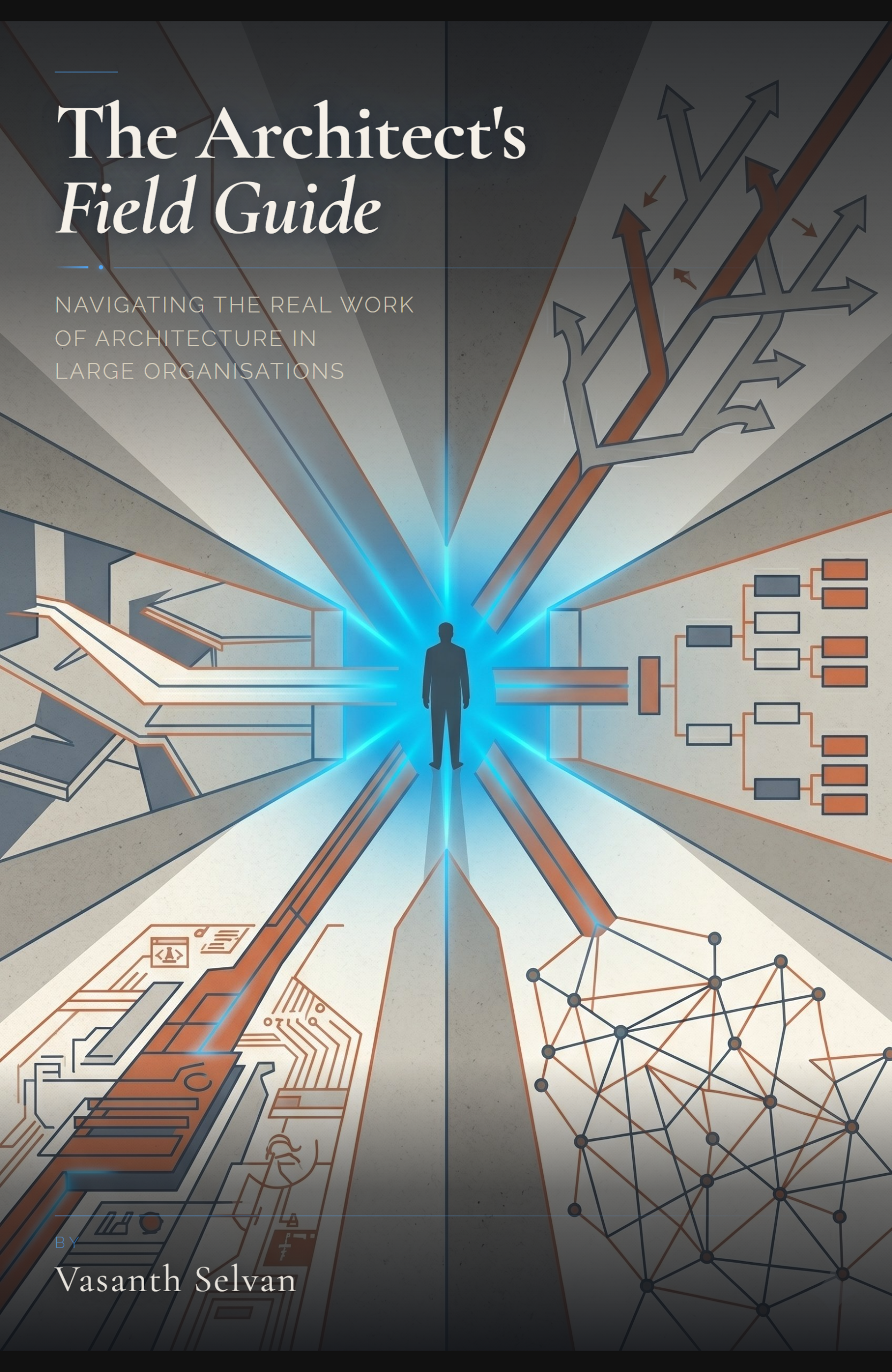
The Architect's Field Guide by Vasanth Selvan - A practitioner's guide to architecture in large organisations
50
situations
6
zones of navigation
25
years of experience

Every architecture course teaches you how to design systems. None of them teach you what to do when two senior stakeholders want incompatible things and both believe you are aligned with them. Or when governance has become the thing preventing the decision. Or when the information you need does not exist yet and the deadline will not move.

Those are not edge cases. They are the job.

The Architect’s Field Guide is written for anyone in architecture or heading towards it. Whether you are just starting out and want to understand what the role really involves, mid-career and navigating situations nobody prepared you for, or senior and looking for a reference that reflects the work as it actually happens. The situations in this guide are universal. The seniority changes. The fundamentals do not.


What is inside
Zone 1
Decisions and Judgement
Making calls with incomplete information, under pressure, without full authority.
This zone is about the decisions that do not have a clean answer. The ones where the process gives you no cover, the information gives you no certainty, and the organisation gives you no authority but still expects you to deliver a position. The difficulty is rarely technical. The hard part is the human and organisational context that surrounds every decision of consequence.
Hover to read more
Zone 2
Influence and Positioning
Building credibility and coalition where you have responsibility but not authority.
Architecture is a role defined by gaps. The gap between the authority you need and the authority you have. The gap between the decision you are trying to shape and the process that controls it. This zone covers how influence actually works in large organisations and how to navigate the political landscape without losing what you stand for.
Hover to read more
Zone 3
Organisational Friction
Navigating structures and cultures that exist to help and often do the opposite.
Large organisations generate friction as a structural condition. Governance processes that slow decisions below the speed the work requires. Committees that produce misalignment. Escalation paths that distribute accountability without resolving anything. This zone covers the situations where the organisation itself is the problem you are navigating.
Hover to read more
Zone 4
Technical Credibility Under Pressure
Holding your ground when your knowledge has limits and the room has expectations.
Technical credibility is not a permanent state. It is earned in every room, in every conversation, and it can be damaged quickly and take a long time to rebuild. This zone covers the situations where your knowledge is being tested and where how you handle that gap matters as much as what you actually know.
Hover to read more
Zone 5
Intellectual Honesty
Knowing when you are wrong, saying so, and staying trusted.
The situations in this zone are about the moments when your own reasoning is the problem. When you are defending a position past the point where the evidence supports it. Intellectual honesty is a discipline, not a disposition. It requires active examination of your own thinking under conditions that make that examination uncomfortable.
Hover to read more
Zone 6
Personal Navigation
The situations that are about you, not the work. Often the hardest ones.
Every zone before this one is about navigating something external. The situations in this zone follow you. They are present in the accumulated weight of a career moving in a direction you may not have consciously chosen. They do not have an organisational answer. They have only you, and the discipline to examine your situation honestly.
Hover to read more

Sample situation
Zone 1  ·  Situation 1
You have been asked for a recommendation but the information you need does not exist yet and the deadline will not move.

The ask sounds reasonable. Someone needs a direction and you are the architect. What they are not saying out loud is that the deadline is not about the information. It is about their timeline, their stakeholder, their commitment that was made before you were involved.

Every assumption you make to fill that gap becomes an implicit commitment. If it holds, nobody notices. If it does not, the accountability lands on you by default.

The guide covers why this is harder than it looks, the traps most architects fall into, the lever that changes the dynamic, and the specific actions that move things forward.


Who this is for
Aspiring architects who want to understand what the role really involves before they are in it.
Architects at every level navigating the gap between what they were taught and what the job actually demands.
Senior architects and technology leaders who want a practical reference for the situations that still catch them out.

About the author
VS
Vasanth Selvan

25 years in financial services architecture. Currently leading a large architecture function at a major UK bank across payments, consumer credit, and platform modernisation. The Field Guide is drawn directly from situations he has been in, observed, or helped others navigate. He writes weekly in The Architect’s Mundane, a newsletter on architecture, transformation, and the reality of execution in large organisations.


The Architect’s Field Guide
PDF download  ·  £12.99  ·  Instant delivery to your inbox on launch