Measured Apathy & Intellectual Honesty: The Yin and Yang of Architecture in Large Organisations
Everything written about senior architecture work is written after the fact.
The strategy succeeded. The strategy stranded. The transformation landed. The transformation failed. The lessons get drawn from a position where the outcome is settled and the writer can see the arc cleanly. That distance is what makes the reflection possible. It is also what makes most of the published work feel slightly unreal to anyone reading it from inside something whose outcome is still open.
Most of the work is not written about. Most of the work is the work that is still happening. The work where you are doing what you believe is right, on a programme whose trajectory you cannot fully read, with people whose interests do not always align with the outcome, in conditions you did not design and cannot change. You do not yet know what this work will become. You will not know for months, possibly longer. The honest position is that the outcome is genuinely unknown, not undisclosed.
This edition is about that condition. What it does to you. What it requires of you. And what the senior version of this role actually involves, which is not the engagement that gets celebrated in leadership content. It is something quieter, harder, and rarely named.
The Condition
The work is sound.
The technical decisions are defensible. The architecture is coherent. The team is engaged. The deliverables that should be moving are moving. By every measure that an outside observer would apply, the programme is in a healthy place.
And yet you are reading something else.
There are signals, and they do not all come from the same direction.
The mandate that commissioned the work may have shifted. Not formally. The work is still on the plan, the budget is still nominally there, the governance forums still meet. But the urgency that opened the door has been redirected to something newer, and the work you are doing is now a continuation of a priority rather than the current expression of one. The room for it to demonstrate value is no longer expanding.
The sponsor who held the conviction for the work may have moved on, leaving the strategy in the hands of replacements who inherit it as a deliverable rather than a belief. The work survives in structure and absent in conviction. The decisions that need active sponsorship from above to land cleanly are now decisions that have to be navigated without it.
The partnership that the work depended on, a vendor, a delivery partner, an internal organisation whose alignment was part of the original architecture, may have weakened. The reasons may have nothing to do with you. Reorganisation on their side, a change in their strategy, a shift in their commercial position. The dependency that was solid when the work was designed is now something you are managing rather than relying on.
The wider organisation may have changed shape around the work. A restructure, a leadership change, a strategic pivot. The work was designed for the organisation that existed when it was commissioned. The organisation it is now being delivered into is not quite the same one, and the assumptions the work was built on are quietly no longer true.
There are other variants. The signals are rarely a single thing. Usually they are two or three of them, layered, each weakening the conditions for the work in a slightly different way. The accumulated effect is the same. The runway in front of the work is shortening, even though no one has said it, and the conditions under which the work was commissioned are no longer the conditions in which it is being delivered.
That is the first failure mode. External trajectory. You can do everything right and still arrive at a point where the work no longer has the room it needs to demonstrate what it was designed to demonstrate.
The second failure mode runs alongside the first and is harder to name because it has faces.
The architectural decisions you know are right are being challenged. Not on their merits. You can absorb a challenge on the merits. A challenge on the merits sharpens the position. This is a different kind of challenge. It is about ownership, about positioning, about who gets credit for the outcome and who is exposed if the outcome is bad. People are making moves that have nothing to do with the work itself and everything to do with their own standing in the organisation. You can read these moves clearly. You can see who is making them and why. You cannot say so directly because saying so would make the situation worse, not better.
The conditions under which the right outcome could land are being slowly eroded from inside the room. Not all at once. In small increments. A scope decision that quietly weakens the architecture but strengthens someone’s territory. A reporting change that obscures a risk you raised. A reframing of an agreed position that subtly shifts the accountability without changing the words. Each move on its own is too small to fight without looking petty. The accumulation of them, over weeks and months, is the condition.
Both failure modes coexist. The runway may shorten. The internal pressure may keep working against the architecture. From inside, they are read simultaneously and they amplify each other. The internal pressure becomes easier to apply when the external runway looks shorter. The external runway becomes harder to defend when the internal coherence has been quietly weakened.
You are not in a failure. You are in something that may become one. Or it may not. The outcome is not yet decided and it will not be decided by the technical quality of your work alone.
The accumulation of these signals, carried over weeks and months and across every conversation in your week, is the condition this edition is about. It is not panic. It is not denial. It is a steady, unresolved reading of the situation that you carry into every meeting, every architecture review, every conversation with your team, and every conversation with the people whose interests are not aligned with the work.
It is the persistent background of your professional life when the work matters and the conditions are uncertain.
What It Does to You
It changes your relationship with your own judgement.
The reading you would normally trust starts to feel suspect. Not because it is wrong. Because the cost of being right is rising. A reading that would have been a routine architectural call six months ago is now a reading you turn over in your head three times before saying out loud. You are not less competent than you were. You are more aware of what each call costs to make in the current conditions. The discipline you spent years building, the one that lets you call a position quickly and stand behind it, is operating in a context where every call has political weight in addition to technical weight. The same judgement, exercised in the same way, lands differently now.
The risk is that you stop trusting the judgement at all and revert to deference, which is a worse position than the one you started from. Deference looks safer in any given meeting. Across a programme it costs you the standing that was the only reason the right outcome had a chance of landing.
It changes your relationship with time.
The horizon you work to shrinks. You start delivering for the week rather than the quarter. The structural decisions that take six months to demonstrate their value become harder to commit to when the runway in front of the work may be three. You catch yourself making choices that prioritise immediate defensibility over long-term coherence. The good decision that takes time to vindicate is not a safe decision when there may not be time.
This is the most corrosive of the internal effects, because the work you do under that compressed horizon is the work you will later look back on and wish you had done differently. Architecture that gets compromised in flight to survive a shorter runway is no longer the architecture the work needed. It looks the same from the outside. It is not the same thing.
It changes your relationship with the work itself.
The thing you would normally do because it is right starts to feel exposed. You become aware, in a way you have not had to be for years, that doing the right thing is not the same as doing the safe thing. The two used to align more often than not in your career. They are no longer aligning reliably. Each time they diverge, you have to make a choice you did not used to have to make consciously.
The work that was the source of satisfaction becomes the source of vigilance. You stop being able to lose yourself in it. The problem-solving that used to be absorbing is now problem-solving in front of an audience whose composition you are reading at the same time as you are working.
It changes your relationship with the people around you.
With the people who depend on you for direction, your team, the engineers, the people whose work intersects with yours, you become more careful in what you say. Not dishonest. Selective. You give them the version that lets them make good decisions about their own work without inheriting the weight of a reading that is not yet conclusive. They notice this even when they do not name it. The ones who have been around you for a while can tell when your reading and your words have moved apart. They do not always ask. They register it.
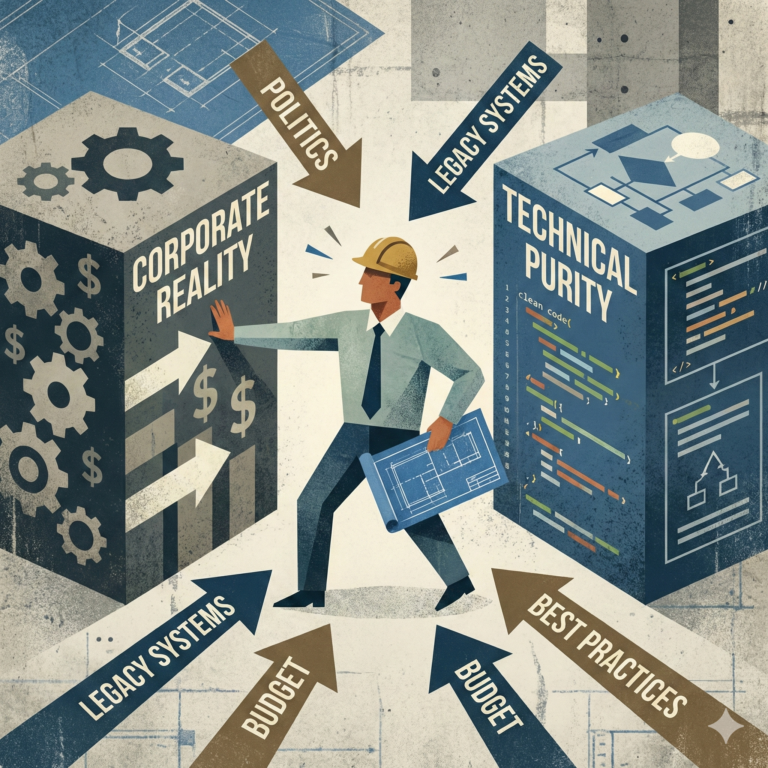
With the people who are causing the disruption, the relationship changes in a different direction. You cannot confront them in the way the situation warrants because the position you would take in that confrontation would expose the architecture to risks that would land before the confrontation could resolve. You cannot disengage either, because they hold influence over the work and the work needs you to remain in contact with them. So you manage them. The energy you put into managing them is energy not put into the work. The relationship becomes a transaction held under sustained tension, which is not the same thing as a working relationship.
It costs you and it costs your team.
The investment in the work is real. The investment in the work is the cost. There is no version of this where the team is fully engaged with the work and the work goes through the condition described above without the team paying for it. They read the same signals you do, sometimes more clearly than you do. They are at the coalface and have to grind through the work regardless of what they are reading. The cost they pay is not visible on any timesheet or budget line. It is paid in attention, in sleep, in the part of them that arrived at work in one state and went home in another. It is paid in the standing meetings they walk into already braced for.
For you, the cost has a different shape because the position you hold means the carrying does not stop. The signals you read in the morning are still being read in the evening. The reading does not switch off when you leave the building because the building is not the source of the signals, the situation is, and the situation is still happening. You carry it home. You carry it into the weekend. You carry it into the conversations you have with the people in your life who can tell that something is being carried but cannot see what it is and cannot help you put it down.
These changes happen even when you do not want them to. The discipline is not to prevent them. The discipline is to notice them and name them to yourself honestly, so they do not operate beneath the surface and do not start making decisions on your behalf without your conscious involvement.
What It Requires
Practice detachment as a skill.
The work matters. The team matters. The outcome matters. None of these things will be improved by the depth of your investment past a certain point. There is a level of investment that produces the standing, the conviction, and the credibility the work needs. There is also a level of investment beyond that which produces nothing additional for the work and produces real cost for you. The skill is recognising the line and refusing to cross it.
This is not indifference. Indifference is not caring. Detachment is caring and refusing to be consumed by it. The two are easy to confuse from outside and obvious from inside. The architect who has practiced detachment is still doing the work, still making the calls, still standing behind the architecture, still present for the team. The architect who has not practiced detachment is doing all of those things plus carrying every meeting home, plus replaying every conversation, plus making the work the only source of self-worth, plus arriving at the next year unable to do any of it.
A certain level of measured apathy is part of this. Not toward the work. Toward the outcomes you do not control. The political moves you cannot prevent. The decisions made above you that you have no input into. The trajectories that will resolve in ways your effort cannot influence. The discipline is to recognise the boundary between what you can affect and what you cannot, and to stop investing emotional weight in the territory beyond that boundary. The investment is not making the situation better. It is making you worse.
The people who last in these conditions are not the ones who cared too little. They are the ones who developed the skill of not caring at the same intensity their early career taught them to bring to everything.
Stay intellectually honest about what you are doing, what is in your control, and what is not.
Apathy without intellectual honesty is corrosion. It is the route to genuine disengagement, to the architect who is still in the room but no longer carrying the work, to the team lead who has stopped seeing what is happening because seeing it costs too much. The apathy has to be paired with a clear, continuous, honest reading of the situation, or it stops being a survival skill and becomes the failure mode it is designed to prevent.
The honesty has several layers. What is actually in your control. The architectural calls you are still making. The standing you are still holding. The conversations with the team that depend on you to be present in them. The reading of the situation that you carry and that has not yet been wrong. These are the territory you are still responsible for and the apathy does not extend to them.
What is not in your control. The shifts in mandate above you. The political moves around the work. The trajectory of the runway. The decisions other people will make that will determine whether the work lands. The apathy belongs here. The intellectual honesty is what keeps you clear about which side of the line each thing sits on, so you do not waste investment on the wrong side or withdraw investment from the right side.
The third layer is the hardest. Protecting yourself against reasoning corruption.
Under sustained pressure, the reasoning you do about your own situation starts to bend. You begin to rationalise positions that you would have rejected on the merits six months earlier. The compromise you would never have accepted starts to feel pragmatic. The colleague whose behaviour you would have called out becomes someone you can work with if you frame it the right way. The architecture you would have defended becomes negotiable in a way that, when you examine it honestly, has more to do with your fatigue than with the technical merits.
This is the failure mode that the apathy can mask if the intellectual honesty is not present. The detachment that lets you survive can quietly become the detachment that lets you stop noticing the bend in your own reasoning. The discipline is to keep checking. To name to yourself, regularly, the positions you are now holding and the positions you would have held twelve months ago, and to ask whether the difference reflects new information or quiet erosion. The answer matters. New information is legitimate. Erosion is the thing the condition is doing to you that you cannot let happen unobserved.
These two together. Apathy toward what you cannot control. Intellectual honesty about what you can, what you cannot, and how your own reasoning is moving under pressure. The senior version of this role lives in the discipline of holding both at once.
Closing
This is the job.
Not the part that gets celebrated. Not the part the role description names. Not the part the leadership content covers. The carrying. The apathy held alongside the honesty. The reading you maintain about your own situation and the discipline of acting on what you can change without spending yourself on what you cannot. The standing held in the conversations that matter. The architecture defended where the merits allow. The team kept oriented to the work that is still in front of them. The reasoning checked against its own erosion. The investment placed where it can reach the outcome and withheld where it cannot.
The conditions described in this edition are not the exception. They are the operating environment of senior work inside large institutions. The mandate that shifts. The sponsor who moves on. The partner who weakens. The colleague whose interests are not aligned with the work. These are not deviations from the design of corporate life. They are the design of corporate life. The work continues inside them, not despite them.
The apathy and the honesty are not what you carry to survive the work. They are what you carry so the work can keep moving. So the architecture you believe in still gets built, even where the conditions for it have to be navigated rather than relied on. So the right outcomes still land, within the limits of what the institution will allow. So the team has someone above them who is reading the situation honestly and acting on it cleanly, rather than someone who has been quietly broken by it.
And so the work continues to be what it has always been. The source of the meaning. The source of the purpose. The reason you have stayed in this for as long as you have, and the reason you will stay in it for as long as you choose to.