When Technical Excellence Is No Longer Enough. The Aperture Shifts.
You do not become a leader overnight. There is no moment. No handover. No clear line between the work you were doing before and the work you are doing now. The transition from architect to leader happens gradually, across roles, across years, across a slowly expanding set of responsibilities that arrive without a manual and accumulate without announcement.
The arc is familiar to many who have lived it. Developer. Designer. Technical lead. Practice lead. Lead architects. Responsible for a team of architects. Each step feels like an extension of the last rather than a departure from it. The technical work does not disappear. The delivery focus does not disappear. The drive to get things done does not disappear. What changes is the unit of delivery, from your own work to your team’s work. From your own standards to the standards of a function you are now responsible for.
That shift sounds straightforward. It is not.
Because the expansion of aperture is not just about scope. It is about the nature of the work itself changing, quietly, without fanfare, and without anyone formally telling you that the skills that carried you here are no longer sufficient on their own.
The first thing that changes is the weight.
As an architect you carry your own expectations. Your own delivery. Your own stakeholder relationships. Your own navigation of the organisational complexity that surrounds every programme you work on. That weight is real and it is significant. But it is yours. You know its shape. You have learned over years how to carry it.
As someone leading a team, you carry all of that and more.
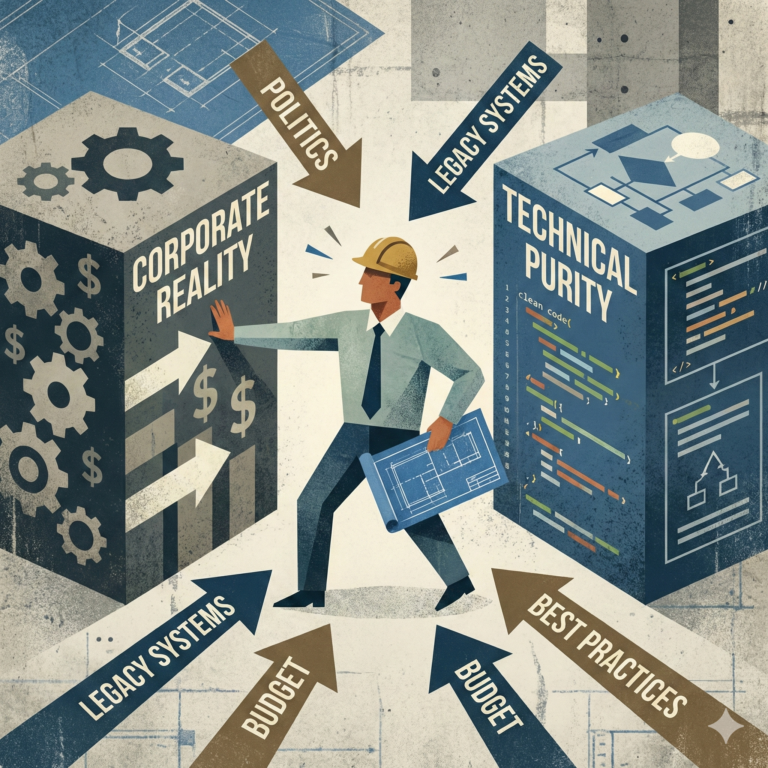
Every architect on your team has their own delivery pressures, their own stakeholder dynamics, their own navigational challenges. And those pressures do not stay with them. They travel upward. The difficult stakeholder who will not engage constructively with your team member becomes your conversation to have. The timeline that cannot be met without a scope negotiation becomes your negotiation to lead. The senior leader applying pressure that is disproportionate to the situation becomes your filter to manage so the team can focus on the work.
This is what filtering pressure actually means in practice. Not a management concept. Not a leadership principle. A daily reality of absorbing what comes from above so the team can operate below without being crushed by it. It does not appear in any job description. It is rarely named explicitly even in the conversations that accompany a move into leadership. It is simply expected, and sometimes not even that. It is discovered, gradually, through the experience of doing it.
The second thing that changes is what matters.
Technical expertise carried you to this point. The depth of knowledge, the quality of decisions, the ability to navigate complex architectural challenges, these built your credibility and made you visible. But the architects who grow into leadership roles are rarely those who are purely technical. They are the ones who display an early affinity for something broader, communication, influence, the ability to read a room and navigate it, the instinct to build relationships rather than just solve problems. That affinity is what gets noticed. That is what creates the visibility that opens the door to leadership.
But stepping through that door reveals a gap that few people name honestly.
What carries you through the leadership role is a different set of skills entirely. Communication. Stakeholder influence. The ability to build and maintain a network across an organisation. The presence to represent your team and your function in rooms where the decisions that shape their work are made. The brand, yours and your team’s, that determines whether the work is seen, valued, and protected.
For anyone aspiring to a leadership role, and for anyone who has recently stepped into one, this is where the challenge lies. Not in the technical work. In the shift of what your value actually is.
As an architect your worth is largely tangible. A decision made. A design delivered. A platform shaped. The evidence of your contribution is visible and measurable. As a leader your value becomes increasingly intangible. The decision that did not go wrong because you were in the room. The pressure that never reached the team because you absorbed it. The relationship that held when it needed to. The team member who grew because you invested in them. None of this appears on a dashboard. None of it is easy to evidence.
Dealing with that shift requires a change in mindset that is its own challenge entirely. The ability to define your own value on your own terms rather than relying on external validation. To find a measure of worth in outcomes that are often invisible to everyone except the people who benefited from them. That is not a technical problem. It is a deeply human one. And it is one that the transition into leadership surfaces whether you are ready for it or not.
The third thing that changes is what you are responsible for.
As an architect your primary responsibility is the work. The quality of the design. The soundness of the decision. The integrity of the solution. People are part of the context, stakeholders to manage, engineers to work alongside, leaders to influence, but the work itself is the object of your focus.
As a leader the people become a central dimension of what you are responsible for.
Not instead of the delivery. Alongside it. And in permanent tension with it. Because the needs of the individual and the needs of the programme are not always the same thing. The team member who needs a stretch assignment to grow may not be the most efficient choice for the critical delivery. The person navigating something difficult personally may need more of your time than the deadline can accommodate. The aspiration someone holds for their career may not align with where the team needs them to be right now.
Holding that tension, between what the work demands and what the person needs, is one of the least discussed and most demanding aspects of the leadership role. It requires a completely different set of tools. Empowerment rather than direction. Delegation that is designed for the growth of the individual rather than the convenience of the leader. Coaching conversations that meet people where they are rather than where the process says they should be. The ability to see beyond the professional to the human reality that sits underneath it.
Some of these tools can be learned. Frameworks exist. Training programmes exist. And they are worth engaging with, they provide structure and language for things that would otherwise remain intuitive and inconsistent.
But the most important parts of this are not in any framework. They are assembled through experience. Through the professional journey that has shaped your instincts about people. And through the personal life that has given you a depth of human understanding that no leadership course can replicate. The leader who connects well with people, who earns genuine trust and commitment, who creates the conditions for others to do their best work, that leader is drawing on something that was built long before they stepped into the role.
Underneath all of it is trust.
Not the kind of trust that leadership frameworks describe in clean, linear terms. Not the leader who delegates and steps back and hopes for the best. The trust that the transition from architect to leader actually demands is bidirectional, dynamic, and earned rather than assumed.
The leader has to trust the team. Trust them with space. With autonomy. With the empowerment to make decisions, navigate stakeholders, and own their work in a way that reflects their capability rather than their leader’s anxiety. That trust is not unconditional. It coexists with the ability to pull back, to challenge, to be direct and sometimes blunt when the work or the approach demands it. Those two things are not contradictory.
Empowerment without the ability to challenge is abdication. Challenge without empowerment is control. The leader who can do both, and knows when to do which, is the one who earns the right to be trusted in return.
Because the team has to trust the leader too. And that trust is harder to earn and easier to lose.
The team will follow a leader who delivers results. They will commit to a leader they believe in. The difference between those two things is significant. Belief comes from something specific, the sense that the leader’s goals are not selfishly driven. That the work being asked of them serves something larger than the leader’s own agenda or career. That their growth, their aspirations, and their development matter as much to the leader as the delivery outcome does.
When that belief exists the commitment that follows is qualitatively different from compliance. It is not people doing what they are asked. It is people investing in the work and in the leader because they feel genuinely included in something worth being part of.
That is not built through a performance framework or a reward structure. It is built through consistency. Through being seen. Through the accumulation of small moments where the leader chose the team’s interest over their own convenience. And through the long game of demonstrating, repeatedly, that the trust the team places in their leader is not misplaced.
Nobody hands you the manual for this transition.
The technical expertise that built your career gives you credibility in the leadership role but not the capability to do it well. The capability is assembled gradually, through the experience of getting it wrong, through the professional journey that shaped your instincts, and through the personal life that gave you a depth of human understanding that no framework can replicate or replace.
The architect who becomes a leader discovers something that is both clarifying and uncomfortable. The work has not become simpler. It has become more complex. Because the systems you are now responsible for are not technical ones. They are human ones. And human systems do not behave like technical ones. They do not respond to elegant design or logical sequencing. They respond to trust, to genuine investment, to the sense that the person leading them sees them as more than a resource to be deployed.
The weight of that responsibility is real. The shift in currency is real. The tension between delivery and people is real. And the trust that holds it all together is the hardest thing to build and the easiest thing to lose.
What the transition from architect to leader actually demands is not the abandonment of everything that made you a good architect. It is the addition of everything that makes you a good human being in a position of responsibility.
The technical foundation remains. But what sits on top of it, the communication, the influence, the genuine investment in people, the ability to carry weight without showing the strain, is learned only one way.
By doing it. By getting it wrong. And by staying long enough to get it right.