The Sludge
Every large organisation has a version of this problem. Delivery that moves slower than the people inside it. Programmes that take longer than anyone can justify. Decisions that seem to have been made but keep resurfacing. Initiatives that are universally supported and somehow never land.
The standard diagnoses are familiar. Technical debt. Unclear requirements. Resource constraints. Competing priorities. Governance overhead. These are real, and they are present, and they are not the primary cause.
The primary cause sits upstream of all of them. It is the way the organisation moves. How it decides. How it commits. How it holds, or fails to hold, the people and roles responsible for outcomes.
In most large organisations, that mechanism is consensus. Or alignment, which is the same thing with a more collaborative tone. Reaching alignment. Getting everyone aligned. Aligning the stakeholders. The language shifts depending on the room, but the mechanism is identical: no decision moves forward until the group agrees, and agreement becomes the proxy for progress.
Consensus and alignment feel inclusive. They surface concerns before they become blockers. They distribute the discomfort of hard decisions across a group rather than concentrating it on one person or one role. Every one of those arguments is true. And none of them changes what consensus and alignment produce as a structural output when they become the primary way an organisation moves.
What they produce is a slow, thickening layer of friction that sits across every workstream, every decision, every delivery boundary in the organisation. Not the friction of productive disagreement. The friction of roles that have learned, rationally and self-protectively, to operate in an environment where accountability has no clear address.
This edition is about that layer. What generates it. What it looks like once it has set. And what the organisations that do not have it did differently.
How consensus dissolves accountability
The accountability problem in a consensus-driven organisation accumulates.
It begins with a reasonable structural instinct. A decision with significant consequences should involve the people affected by it. A design choice that cuts across multiple teams should not be made unilaterally. A commitment requiring delivery from several functions should carry their agreement. These are not wrong premises. The problem is what happens when the mechanism for satisfying them becomes the default setting for every decision, at every level, regardless of consequence.
When consensus is required to move, the role that actually carries the accountability gets diluted. Everyone else in the room, the functions consulted, the steering committees convened, the stakeholders aligned, carries no real accountability at all. What they carry is opinion. And in a consensus culture, opinion becomes a proxy for judgement. The louder the voice, the more friction it generates for the decision the accountable role actually has to make. The stronger the influence, the harder execution becomes. At its worst, this tips into active sabotage, where individuals or functions use the consensus process to drive local agendas, blocking or slowing decisions that do not serve their position. The famous disagree and commit rarely survives contact with an organisation where consensus holds sway. People disagree, and then they do not commit. Or they commit in the room and quietly undermine outside it.
The science is unambiguous on why this happens. Research in Organizational Behavior and Human Decision Processes found that individual accountability actively staves off excessive consensus-seeking, produces a better power balance within the group, and leads to less risky decisions. The social psychology literature names the structural cause through the concept of diffusion of responsibility: the more people present in a decision, the less any individual feels personally responsible for its outcome. Put those two findings together and the picture is clear. Consensus does not distribute accountability across a group. It destroys it. The role that was supposed to own the decision still carries the formal accountability on paper, but the lived experience of that accountability has been diluted to the point where it cannot drive behaviour. Everyone else in the room contributed an opinion and left with no skin in the game. The accountable role is left holding a decision that has been shaped, pressured, and in some cases hollowed out by voices that will face no consequence if it fails.
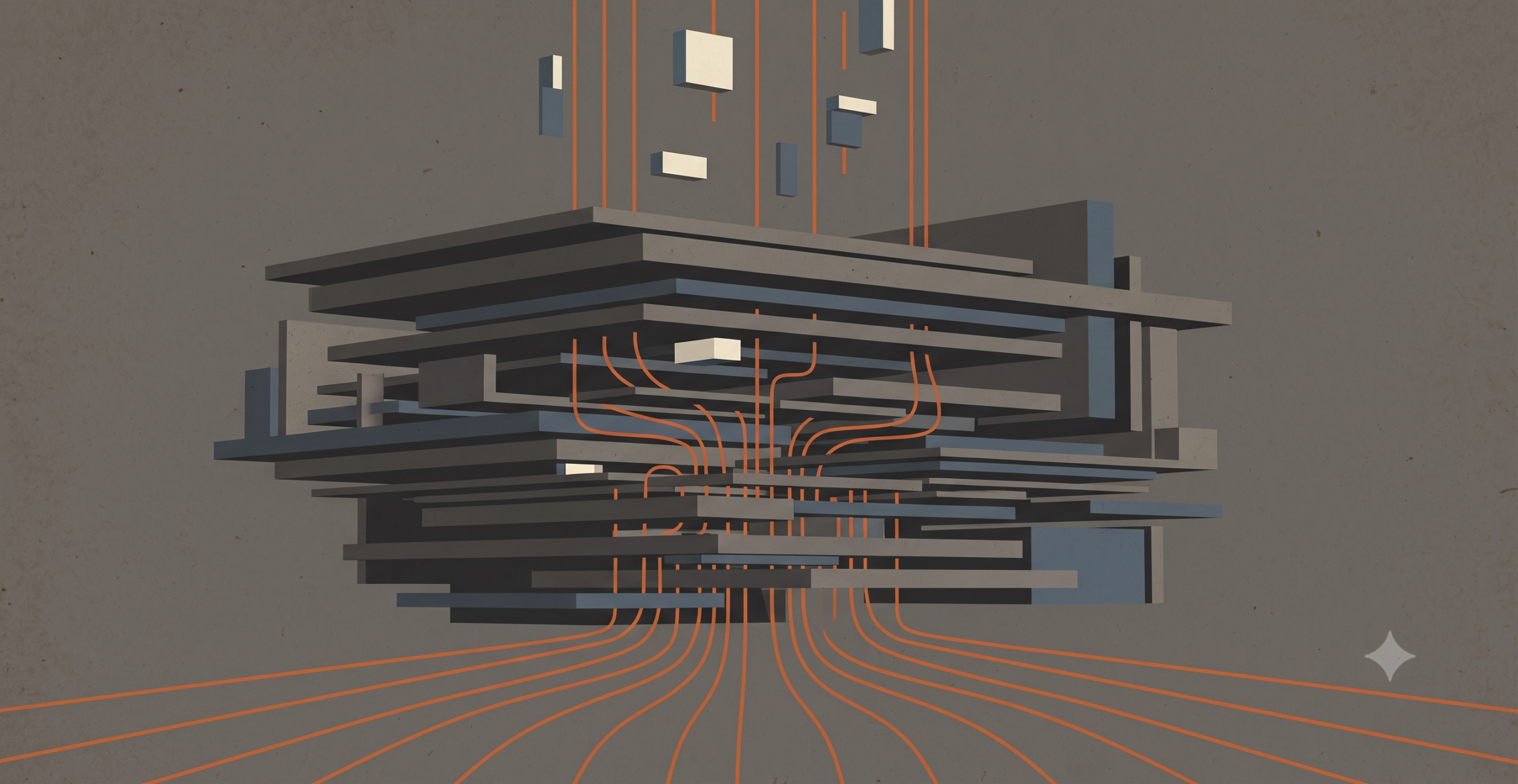
Over time that deposit accumulates. Decisions made in three separate forums that still feel unresolved. Workstreams with full stakeholder alignment and no clear owner. Programmes with governance documentation that would satisfy any audit and delivery timelines that satisfy no one. The layer is not visible on any dashboard. It does not appear in any risk register. It is the ambient condition of how the organisation moves. That condition is what this edition calls the sludge. A structural description of what accumulated, dissolved accountability produces in the operating environment of a large organisation.
The active deterioration
What happens next is not passive. This is the part that rarely gets named.
Once accountability has been sufficiently dissolved through consensus and alignment, roles do not settle into a neutral state of shared ownership. They adapt. The people inside those roles are not disengaged or incompetent. They are rational. They are reading the environment they are operating in and responding to it logically. And the environment is telling them two things with consistent clarity: that blame travels fast and lands hard, and that credit is available to those who position themselves correctly.
The result is a set of behaviours that emerge not from character but from structure. They are the predictable output of an organisation that has made consensus its primary operating mechanism and in doing so has made accountability genuinely dangerous to hold.
The first behaviour is blame shifting. When something goes wrong in a consensus culture, the absence of clear ownership does not produce honest reflection on what failed. It produces a competition to establish distance from the failure. Research published in the Journal of Experimental Social Psychology found that blame shifting in organisations is not just common, it is contagious. Nearly 80 percent of participants who had been exposed to blame shifting behaviour pointed the finger at others for their own mistakes, compared to just under 40 percent in the control group. The mechanism is not mood or moral permissiveness. It is self-image protection. Watching someone else shift blame activates the same instinct in the observer. In an organisation where blame shifting is already present, it spreads structurally, through observation and imitation, until it becomes the default response to any failure regardless of who was actually responsible. Roulet and Pichler’s blame game theory, published in Organisation Theory, documents this as a predictable sequence: organisations and their members employ discursive strategies to strategically shift blame by attributing responsibility to others or denying misconduct, and those strategies follow recognisable patterns that repeat across organisations and industries.
The second behaviour runs in the opposite direction but from the same instinct. If blame is to be avoided, credit is to be accumulated. Roles in consensus cultures develop a sophisticated sensitivity to which initiatives are moving, which decisions are landing well, and which forums offer visibility. They associate themselves with successes that are not wholly theirs. They ensure their contribution to positive outcomes is visible while their proximity to failing ones quietly reduces. Research on credit claiming published in Frontiers in Psychology found that leaders’ credit claiming behaviour generates anger and perceived unfairness in those whose contributions are appropriated, and that the damage compounds when the behaviour is seen as intentional rather than structural. In a consensus culture it is almost always structural. The absence of clear ownership creates a vacuum that credit claiming fills. Nobody designed it. The environment produced it.
What makes this layer so destructive is not the presence of either behaviour in isolation. It is the friction generated when both are operating simultaneously across every role and every function. Roles are actively working to avoid accountability for failure at precisely the same moment they are actively working to claim association with success. Every boundary between functions becomes a surface for that friction. Every delivery dependency becomes a potential site of blame displacement. Every governance forum becomes a theatre in which credit is accumulated and accountability is managed rather than held.
This is the sludge in its active state. Not slow delivery as an unfortunate byproduct of complexity. Organisational energy being spent, at scale, on accountability navigation rather than accountability execution. The people are working hard. The work is simply pointed in the wrong direction.
The organisations that did it differently
The argument so far is structural and observable. The evidence that accountability-driven organisations outperform consensus-driven ones is external, measurable, and available across industries.
ING Bank is the first proof point precisely because it sits inside the sector where consensus governance is most deeply embedded. Regulated, large, European, with all the structural conditions that produce the sludge described above. ING’s own diagnosis was direct: as long as you continue to have different departments, steering committees, project managers, and project directors, you will continue to have silos. The response was not a culture programme. It was a structural redesign. Thousands of employees were reorganised away from functional departments into small, multidisciplinary squads with end-to-end ownership of specific outcomes. No shared accountability. No consensus required to move. Each squad held a defined purpose, a named owner, and a clear measure of impact. The results were felt in delivery speed, employee engagement, and time to market, all of which improved materially. The mechanism was not motivation or engagement. It was the removal of the structural condition that had been generating the friction.
Bayer, one of the largest life sciences organisations in the world, faced a version of the same problem at comparable scale. A century-old hierarchical structure with deep functional silos, complex governance, and the accumulated weight of consensus-driven decision making across a global organisation. Rather than restructuring into slightly different hierarchical forms, Bayer introduced what it called Dynamic Shared Ownership, a model designed to push decision-making authority and accountability directly to the people closest to the work. Management layers were reduced. Teams were given explicit ownership of outcomes rather than participation in processes. The shift was structural and deliberate: from a model where accountability was distributed across governance layers to one where it was anchored to specific roles with the authority to match. The outcomes included faster decision making, reduced bureaucratic drag, and measurably improved organisational responsiveness.
Haier, the Chinese appliance manufacturer, ran the most radical version of this experiment at the largest scale. Facing the structural inertia of a massive hierarchical organisation, Haier did not restructure into larger accountable units. It went the other direction entirely, replacing its hierarchy with thousands of microenterprises, each operating as an independent unit with direct accountability to customers and its own profit and loss responsibility. Each microenterprise held decision-making autonomy across strategy, people, and reward. There was no consensus process to shelter inside, no alignment forum to delay a commitment, no shared ownership to dilute the consequence of getting it wrong. The transformation produced faster decisions, shorter paths from insight to delivery, and an organisational model that has since been studied by business schools and adopted in various forms by organisations across multiple industries.
Three organisations. Three different industries and geographies. The same structural finding. When you remove the ambiguity of who owns what and replace it with accountability that is specific, named, and consequential, organisations move faster, deliver more, and produce better outcomes. Not because the people changed. Because the structural condition that had been generating the friction was removed.
The cost of the model
The organisations described above did not outperform their peers because they hired better people, built better technology, or found better strategies. They outperformed because they changed the structural condition that was preventing the people, technology, and strategy they already had from delivering what they were capable of.
That structural condition has a name. It is consensus and alignment as the primary mechanism through which an organisation moves. And the cost of that mechanism is not visible on any balance sheet, any delivery dashboard, or any governance report. It is carried silently, in the accumulated weight of dissolved accountability, in the energy spent navigating blame and accumulating credit, in the decisions that have been aligned to death and still have no clear owner.
The alternative is not a harsher organisation. It is a cleaner one.
Accountability driven organisations are not built on the assumption that people cannot be trusted or that disagreement should be suppressed. They are built on the assumption that every role exists for a reason, carries a defined purpose, and should be given the authority and the expectation to deliver against it. Inclusion does not disappear in an accountability driven organisation. Expertise is still consulted. Concerns are still surfaced. The difference is that consultation does not become a substitute for ownership. Opinion does not become a proxy for decision. The role that carries the accountability makes the call, holds the consequence, and owns the outcome. Everyone else plays their part without diluting the clarity of who is responsible for what.
That clarity is what changes behaviour. Not because people are forced into it but because the structural environment stops producing the incentives that work against it. When accountability is clear and named, blame shifting has nowhere to go. When ownership is specific and consequential, credit claiming loses its structural cover. When a role knows it will carry the outcome, it stops navigating the governance environment and starts working the problem.
This is what ING, Bayer, and Haier demonstrated at scale. Not that accountability is a harder way to run an organisation. That it is a more honest one. One that respects the capability of the people inside it enough to give them something real to own. And that in doing so, releases the organisational potential that consensus and alignment, for all their inclusivity, consistently hold back.
Large organisations that make this shift do not just deliver faster. They find out what they were actually capable of all along.